


The Architectural Legacy of
Charles
M. Robinson
Across Virginia, hundreds of schools, college buildings, churches, hospitals, theaters, civic buildings, and commercial landmarks continue to tell the story of Charles M. Robinson’s remarkable career. More than a century later, his work remains woven into the everyday lives of communities throughout the Commonwealth.

ABOUT THIS DIGITAL ARCHIVE
This site is dedicated to documenting, preserving, and sharing the architectural legacy of Charles M. Robinson for future generations. Through original research, historic photographs, architectural drawings, and the most comprehensive census of Robinson’s known work assembled to date, this living archive seeks to preserve one of Virginia’s most significant architectural legacies while making it accessible to researchers, preservationists, students, and the public.
One Architect.
Hundreds of Buildings.
A Lasting Legacy.
The influence of Charles M. Robinson cannot be measured by a single building. It is found in the remarkable breadth of his work—schools that educated generations of Virginians, university campuses that continue to grow, hospitals that cared for their communities, churches that became neighborhood landmarks, and public buildings that helped shape the character of cities and towns across Virginia.


700+
DOCUMENTED
WORKS
The most complete public record of Charles M. Robinson’s architectural legacy assembled to date.

400+
VA. SCHOOL PROJECTS
Educational architecture was the defining focus of Robinson’s career in Virginia.

1,000+
PROJECTS DIRECTED
An extraordinary body of work spanning more than four decades.

$739M+
IN COMPLETED WORKS
A remarkable measure of the impact and scale of Robinson’s work across Virginia. (inflation-adjusted figure)
— BRUCE ROBINSON, SPEAKING TO THIS ARCHIVE'S CURATOR, DAVID B. ROBINSON, CPA IN 1977 ABOUT CHARLES M. ROBINSON'S BODY OF WORK
“
The scope of it is so enormous, it is difficult to understand.”

SELECTED WORKS
These selected works offer an introduction to the breadth of Charles M. Robinson’s career, from schools and university buildings to churches, hospitals, theaters, and civic architecture. If you’ve spent time in Virginia, there’s a good chance you’ve encountered at least some of these buildings. Together, they represent only a small portion of the more than 700 documented projects preserved in this archive.

Cannon Memorial Chapel
University of Richmond, 1927

College of William & Mary Master Plan
Williamsburg, 1920

James Madison University Master Plan
Harrisonburg, 1907

Radford Campus Master Plan
Radford, VA 1911

The Mosque
Richmond, Virginia 1925
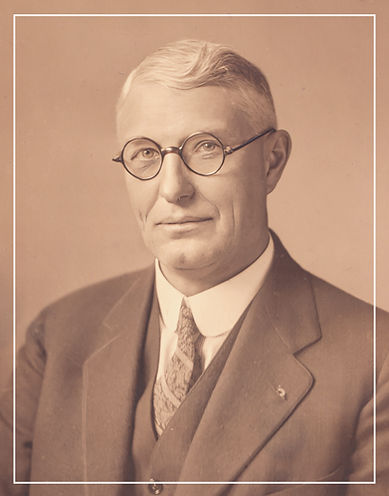
The Man Behind the Buildings
Charles Morrison Robinson was born in Hamilton, Virginia, in 1867. After establishing successful architectural practices in Pennsylvania, he returned to Virginia in 1906 and opened a Richmond office that would become one of the Commonwealth’s most productive architectural firms.
During the next twenty-five years, Robinson designed hundreds of school buildings while also creating churches, hospitals, theaters, commercial buildings, government buildings, private residences, and many of Virginia’s best-known college buildings.
His work helped shape the physical landscape of Virginia during a period of extraordinary growth and continues to influence communities throughout the Commonwealth today.

Explore the Complete Works
The story of Charles M. Robinson cannot be told through a handful of famous buildings alone.
Search and browse more than 700 documented projects spanning schools, colleges, churches, hospitals, civic buildings, commercial architecture, residences, and more. Every project contributes another piece to the story of one of Virginia’s most remarkable architectural legacies.
EXPLORE


Continue the Story
This website is a full census of Charles M. Robinson’s work, but only contains an abbreviated telling of his full story.
Currently in development, the companion book to this website will explore his life and work in far greater depth through expanded historical research, original architectural drawings, historic photographs, and the stories behind the buildings.
The book is planned to release digitally on Kindle, Apple Books, Kobo, and most reading apps.
Whether you’re researching in more detail, exploring Virginia’s architectural history, or simply curious to learn more, the book will offer the most comprehensive account of Charles M. Robinson’s remarkable career assembled to date. Check back soon for more details.